

EV Chargers, Solar Panels, and Home Electrical Standards: What the Numbers Actually Show
How many EVs are being added every year? Do solar panels still pay off? What does a home actually need to be ready for today — not five years ago? And what happens in a condo with zero chargers?
Modern homes need at least 200-amp electrical service to handle today’s demand from EVs, solar, battery backup, and smart systems. Solar panels still make financial sense in Florida — payback runs 10 to 13 years after the federal tax credit expired in 2025, with homes selling for up to 6.9% more. Over 1.3 million battery EVs were sold in the US in 2024 alone. For home charging, Level 2 (240V) is the only option that matters. And Florida law gives condo owners the right to install an EV charger in their assigned space — but old building wiring is the real obstacle.
Part 1 covered the landscape: why electrical infrastructure is becoming a real estate feature, what buyers should ask, and what sellers should know before listing. This section goes deeper with current data, real comparisons, and Florida-specific details that should be part of every transaction conversation.
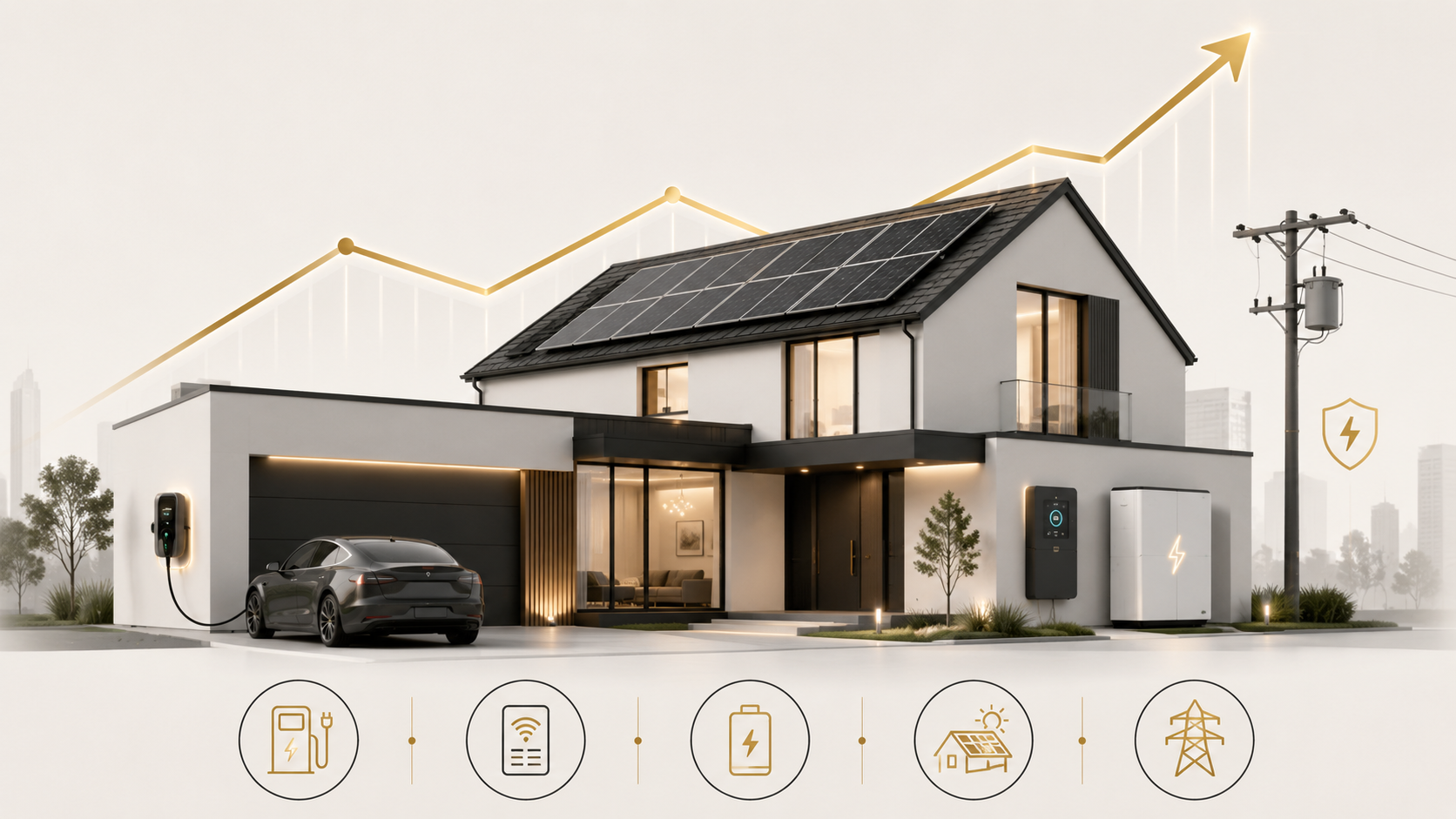
Section 1: What a Modern Home Actually Needs — Electrical Minimums Today
A lot of homes on the market are running on infrastructure designed for a very different era. Understanding what the current standards actually require — and where your property stands — is no longer optional for a serious buyer or seller.
The Code Baseline
The National Electrical Code (NEC) sets the minimum service size at 100 amps for single-family homes. That number has not changed in decades. But 100 amps is not what anyone is building to anymore.
200-amp service is the current standard for new construction — and has been for some time. It handles modern demand from HVAC, appliances, electronics, and basic EV charging. Anything less than 200 amps in a home today raises legitimate questions during inspection.
For homes with pools, multiple HVAC zones, EV charging, battery backup, or larger footprints, 320 to 400-amp service may be necessary. That is not unusual in South Florida luxury or estate-level properties.
The 2024 NEC Updates: Two Changes That Now Apply
The 2024 National Electrical Code introduced two requirements now being adopted across Florida:
1. Surge protection on every electrical panel. New installations and panel upgrades now require whole-panel surge protection. Relevant for buyers reviewing recent electrical work and sellers disclosing upgrades.
2. Exterior service disconnect. Every home must now have a service disconnect switch located outside the property, allowing emergency responders to cut power without entering the structure — a meaningful safety feature in hurricane-prone markets.
What a 100-Amp or Older Panel Means at the Negotiating Table
Older panels — particularly 60-amp fuse boxes, Federal Pacific, and Zinsco brands — are known insurance concerns in Florida. Some carriers will not write policies on homes with these panels, or require replacement as a condition of coverage.
A buyer who wants EV charging, solar, or battery backup and finds a 100-amp panel is looking at a $3,000 to $8,000 panel upgrade as a near-term expense — before they even get to the charger itself. That is a negotiating point, a pricing consideration, and a disclosure item that smart agents surface early.
| Panel / Service Size | What It Supports Today | What It Limits |
|---|---|---|
| 60-amp or older fuse box | Basic lighting and outlets | Nearly everything modern — often an insurance issue |
| 100-amp | Gas-appliance homes without high electrical load | EV charging, solar, battery backup, heavy HVAC |
| 150-amp | Moderate load homes | May limit simultaneous EV charging and high-demand appliances |
| 200-amp | Current standard — handles most modern demand | May need subpanel for large pool, multiple EVs, or battery systems |
| 320–400-amp | Full modern demand: multiple EVs, full solar + battery, pool, HVAC, home office | Very few residential limitations |
A licensed electrician must evaluate any specific property before conclusions are drawn about capacity or required upgrades. This table is for general orientation only.
Section 2: Solar Panels in Florida — Is the Investment Still There?
The Big Change: The 30% Federal Tax Credit Is Gone
The 30% federal Residential Clean Energy Credit expired at the end of 2025 under the One Big Beautiful Bill Act. For systems installed in 2026 or later, it no longer applies. That is a meaningful shift — it was one of the primary reasons solar penciled out so cleanly for many homeowners over the past several years.
What Still Works in Florida’s Favor
Full-retail net metering. Florida utilities pay homeowners the full retail rate for excess solar energy sent back to the grid. Many states have moved to below-retail buyback rates. Florida’s policy survives for now, making the math more favorable than in most states.
Property tax exemption. Under Florida Statute 193.624, the added value from a solar system is exempt from property tax assessment. A home that becomes more valuable because of solar does not get hit with a higher tax bill for it.
No sales tax on solar equipment. Florida exempts solar equipment purchases from state sales tax.
Sunshine. Florida averages around 237 sunny days per year and approximately 5.4 peak sun hours per day — among the highest in the country.
Current Solar Economics: The Honest Numbers
The payback window extended when the federal credit disappeared. That does not mean solar stopped making sense. It means the analysis matters more than it did before. The clearest case: a homeowner using at least 500 kWh per month (the Florida average is 1,142 kWh), planning to stay at least 7 to 10 years, who can purchase the system outright or finance it at a payment lower than the current utility bill. FPL and Duke Energy customers are also looking at rate increases through at least 2029.
“Are solar panels worth it in Florida?” — For most homeowners who use over 500 kWh per month, plan to stay in the home at least seven to ten years, and own the system outright, solar still makes financial sense in Florida in 2026. The federal tax credit is gone, but full-retail net metering, a property tax exemption, and no sales tax on equipment still support the investment. Payback periods now run 10 to 13 years.
What About Battery Backup?
Battery backup paired with solar is a different financial conversation than solar alone. A Tesla Powerwall costs around $15,600 installed — nearly doubling the cost of a basic solar system. Florida’s net metering policy means the battery does not add financial return on its own. What it adds is resilience: keeping lights, a refrigerator, and medical equipment running during multi-day hurricane outages. That is a lifestyle and safety decision, not just a financial one.
What Sellers Need to Know About Solar When Listing
If you own the system outright, get your documentation ready: permits, installation records, warranty, utility interconnection agreement, and recent energy bills. Buyers want real numbers, not vague promises.
If the system is leased or under a power purchase agreement, the conversation is more complicated. The lease may need to transfer to the buyer, require credit approval, or carry obligations the buyer does not want. Some buyers will walk from a leased solar deal. Disclose this clearly and early.
Section 3: How Many Electric Vehicles Are Actually Being Added Each Year?
US EV sales hit 1.3 million in 2024, representing about 8% of all new light-duty vehicles sold. When plug-in hybrids are included, electrified vehicles accounted for over 20% of new car sales. From 2020 to 2024, US EV sales grew at an average of 47% per year.
2025 was more complicated. A record Q3 was followed by a sharp Q4 collapse after the $7,500 federal EV tax credit expired in late September. Full-year 2025 sales came in just under 2024’s total — the second-highest year on record. Globally, 2025 hit approximately 20.7 million EVs sold.
What This Means for Real Estate
There are now roughly 4 to 5 million battery EVs registered in the US, with millions more plug-in hybrids on the road. Every one of those owners has a charging situation — and most prefer to charge at home. This is not a future buyer pool. It is the current buyer pool.
The stat that matters most for listings: MLS mentions of EV charging increased 91.6% in 2025 versus 2024. Buyers are asking for it. Agents have learned to flag it. Sellers who have it and don’t mention it are leaving a feature on the table.
Section 4: Level 1, Level 2, and Level 3 — Not All Chargers Are the Same
Standard Outlet Charging
Voltage: 120V (standard household outlet)
Speed: 2–5 miles of range per hour
Full charge time: 20–50 hours for a full battery EV
Install cost: Nothing — uses existing outlet
Real estate relevance: Minimal. Any home with a garage outlet technically supports Level 1. Not a meaningful selling feature.
The Residential Standard
Voltage: 240V (dedicated circuit — same as dryer or HVAC)
Speed: 10–60 miles of range per hour
Full charge time: 4–10 hours overnight
Install cost: $800–$2,500 including equipment and labor
Real estate relevance: This is what buyers mean when they ask about a charger. An installed, permitted Level 2 unit is a genuine feature. 84% of home-charging EV owners use Level 2.
Commercial Fast Charging
Voltage: 400–1,000V DC
Speed: 60–100 miles in 20 minutes
Full charge time: 20–60 minutes to 80%
Install cost: $18,000–$350,000+ per port
Real estate relevance: Not residential. Belongs at gas stations, retail centers, and highway corridors.
What Makes One Level 2 Charger Better Than Another?
| Feature | Basic Level 2 | Better Level 2 |
|---|---|---|
| Amperage | 16–24 amps (~10–20 mi/hr) | 32–48 amps (25–60 mi/hr) |
| Smart features | None — plug in and charge | Wi-Fi, app control, scheduling, energy tracking, solar integration |
| Connector standard | Older J1772 only | NACS (now standard) or dual-port |
| Load management | Fixed draw on the panel | Adjusts charge rate based on home energy demand |
| Weather rating | Basic indoor/covered use | NEMA 3R or NEMA 4 — rated for outdoor Florida conditions |
| Warranty | 1–2 years | 3–5 years with manufacturer support |
Section 5: Condos with Zero Chargers — Florida Law, Real Obstacles, and What Is Actually Moving
What Florida Law Says
Under Florida Statute 718.113(8) and (9), condominium associations cannot prohibit unit owners from installing an EV charging station in their designated limited common element parking space. Additionally, a condo board — not the full membership — can install charging stations on common elements without a unit owner vote, treating the cost as a common expense.
| Rule Under Florida Statute 718.113 | What It Means in Practice |
|---|---|
| Association cannot prohibit installation in your assigned parking space | Legal right to install — but only in your designated space and only if conditions are met |
| Electricity must be separately metered or sub-metered | Charging costs cannot fall on all owners — must be tracked to the individual unit |
| Owner pays all installation, operation, maintenance, and removal costs | Not a shared expense unless the board installs a common-element system |
| Must use a licensed electrical contractor | No DIY. Permits required. Association can require proof. |
| Association can require insurance naming them as additional insured | Add-on cost — usually minor but must be budgeted |
| Installation must not cause irreparable damage to the property | Where old building electrical capacity becomes a legal gray area |
The Real Obstacle: Electrical Capacity in Older Buildings
The law says you can install a charger. But many older South Florida condo buildings were built with just enough capacity for the appliances and lighting of their era. Adding even a few Level 2 chargers can require a major infrastructure upgrade: new transformer capacity from the utility, panel upgrades, new wiring through concrete, and utility coordination that takes months. The statute does not clearly answer who pays for that underlying infrastructure — the unit owner requesting or the association as a shared upgrade. That is an unresolved area currently being worked through by Florida condo attorneys.
What Is Moving: Managed Charging Networks for Multifamily
A growing number of third-party EV charging companies now specialize in multifamily retrofit installations. The model gaining traction: the company installs the equipment, handles maintenance, and charges users per session while the property owner or HOA gets a revenue share or a no-cost amenity upgrade. This solves the upfront cost, maintenance responsibility, and metering complexity that stopped most condo boards from acting. For a board trying to meet owner demand without a capital project fight, it is worth evaluating.
If You Are Buying a Condo
- Ask whether the building has any existing EV chargers
- Ask about the building’s total electrical service capacity and available load
- Review the declaration for provisions that conflict with Florida Statute 718.113
- Ask whether any owners have already installed chargers and how it went
- Find out whether the board has discussed a common-element charging program
- Factor potential installation cost and timeline into your decision if you own an EV now
If You Are Selling a Condo
- If your building has chargers, make it visible in the listing — it differentiates the property
- If the building has none, be prepared for EV-owner buyers to ask hard questions
- Know whether your association has a written EV charger policy under 718.113
- If your space has a charger you installed, have the permit documentation ready
- Understand how metering works so you can answer buyer questions accurately
| License | BK0625118 — Florida Real Estate Broker |
| Brokerage | Canvas Real Estate — Weston & Doral/Fort Lauderdale, FL |
| School | JGRES — Joaquin Gutierrez Real Estate School |
| Coaching Brand | The Adept Agent |
| Market Focus | Miami-Dade, Broward, Palm Beach — Bilingual English/Spanish |
| Experience | 30+ years — Residential, Commercial, New Construction |
| Contact | WhatsApp +1 (305) 785-6596 |
| Website | YouBetterCallMe.com |
Bringing It Together: What These Five Areas Mean for Your Next Transaction
The electrical conversation in real estate is no longer abstract. It has numbers behind it, laws governing it, and a buyer pool already asking about it.
1. A home with 100-amp service is not adequately prepared for modern demand. 200-amp is the floor, and anything less is a negotiating issue in many transactions today.
2. Solar still makes sense in Florida for the right buyer, but the economics changed in 2026. The 30% federal credit is gone. The case now rests on net metering, rising utility rates, and a long enough hold period. Know owned vs. leased before the listing goes live.
3. Over 1.3 million battery EVs sold in the US in 2024 alone. EV owners are the current buyer pool — not a future one.
4. Level 2 is the only charger that matters for residential real estate. Know what was installed, whether it is permitted, and what amperage it runs.
5. Florida law gives condo owners the right to install EV chargers in their assigned space — but the statute does not solve old wiring or limited building capacity.
Frequently Asked Questions
Have Questions About a Specific Property?
Before you make an offer or accept one, let’s look at the full picture — including the infrastructure questions most agents miss.
Talk to Joaquin on WhatsAppThinking About Listing in South Florida?
Buyers are asking better questions. Let’s make sure your property has better answers.
Request a Listing ConsultationThis article is for general real estate education only and does not constitute legal, tax, financial, or electrical engineering advice. Solar ROI, electrical requirements, EV charging regulations, and HOA rules change frequently. Verify current conditions with licensed professionals, your HOA attorney, your utility company, and local building department before making decisions. All data reflects publicly available sources as of mid-2026.
Las casas modernas necesitan al menos 200 amperios de servicio eléctrico para manejar la demanda actual de vehículos eléctricos, solar, baterías de respaldo y sistemas inteligentes. Los paneles solares siguen teniendo sentido financiero en Florida — el período de recuperación ahora es de 10 a 13 años tras la expiración del crédito federal en 2025, y las casas con solar se venden hasta un 6.9% más. Se vendieron más de 1.3 millones de EVs en EE.UU. solo en 2024. Para carga residencial, el Nivel 2 (240V) es la única opción relevante. Y la ley de Florida le da al propietario de un condominio el derecho a instalar un cargador en su espacio — pero el cableado antiguo del edificio es el obstáculo real.
La Parte 1 cubrió el panorama general: por qué la infraestructura eléctrica se está convirtiendo en un factor de valor inmobiliario, qué deben preguntar los compradores y qué deben saber los vendedores antes de publicar su propiedad. Esta sección va más a fondo con datos actuales, comparaciones concretas y detalles específicos de Florida.
Sección 1: Lo Que Realmente Necesita Una Casa Moderna — Los Mínimos Eléctricos de Hoy
Muchas propiedades en el mercado funcionan con infraestructura diseñada para otra era. Entender los estándares actuales — y dónde está tu propiedad — ya no es opcional para compradores o vendedores serios.
El Código Eléctrico Nacional establece 100 amperios como el mínimo para viviendas unifamiliares. Ese número no ha cambiado en décadas. Pero 100 amperios no es lo que nadie está construyendo hoy. El servicio de 200 amperios es el estándar actual para construcción nueva. Cualquier cosa menor genera preguntas legítimas durante la inspección. Para casas con piscinas, múltiples zonas de HVAC, vehículos eléctricos o baterías de respaldo, puede ser necesario un servicio de 320 a 400 amperios.
Las Actualizaciones del NEC 2024
1. Protección contra sobretensión en cada panel. Las nuevas instalaciones y actualizaciones ahora requieren protección general. 2. Desconexión exterior del servicio. Toda vivienda debe tener un interruptor de desconexión fuera de la propiedad para que los equipos de emergencia puedan cortar la corriente sin entrar al edificio.
| Panel / Capacidad | Lo Que Soporta Hoy | Lo Que Limita |
|---|---|---|
| 60A o caja de fusibles | Luces básicas y enchufes | Casi todo lo moderno — problema de seguro |
| 100A | Casas con gas sin alta demanda eléctrica | Carga EV, solar, batería, HVAC potente |
| 200A | Estándar actual — maneja la mayoría de la demanda moderna | Puede necesitar subpanel para múltiples EVs o baterías |
| 320–400A | Demanda moderna completa: múltiples EVs, solar + batería, piscina, HVAC | Muy pocas limitaciones residenciales |
Sección 2: Paneles Solares en Florida — ¿Sigue Siendo una Buena Inversión?
El Gran Cambio: El Crédito Federal del 30% Ya No Existe
El crédito federal del 30% venció a finales de 2025. Para sistemas instalados en 2026 o después, ya no aplica. Cualquier oferta solar que todavía lo mencione está trabajando con información desactualizada.
Lo que todavía funciona a favor de Florida: Net metering a precio completo (las empresas eléctricas pagan el precio de venta por la energía enviada a la red), exención del impuesto a la propiedad bajo el Estatuto 193.624 de Florida, y sin impuesto de ventas en equipos solares. Florida también promedia 237 días soleados al año con 5.4 horas pico de sol — entre los más altos del país.
“¿Valen la pena los paneles solares en Florida?” — Para la mayoría de los propietarios que usan más de 500 kWh al mes, planean quedarse en la propiedad al menos siete a diez años y pueden comprar el sistema directamente, solar sigue teniendo sentido financiero en Florida en 2026. El crédito federal expiró, pero el net metering a precio completo, la exención del impuesto a la propiedad y sin impuesto de ventas en equipos siguen apoyando la inversión. El período de recuperación ahora es de 10 a 13 años.
Si el sistema es propio, tenga lista la documentación: permisos, registros de instalación, garantía, acuerdo de interconexión y facturas recientes. Si está arrendado, el contrato puede necesitar transferirse al comprador — algunos compradores rechazarán la propiedad por esto. Divulgar con claridad y anticipación es obligatorio.
Sección 3: ¿Cuántos Vehículos Eléctricos Se Venden Cada Año?
Las ventas de EVs en EE.UU. llegaron a 1.3 millones en 2024 — alrededor del 8% de todos los vehículos nuevos. Incluyendo híbridos enchufables, los vehículos electrificados representaron más del 20% de las ventas. Lo que más importa para bienes raíces: las menciones de carga EV en listados del MLS aumentaron un 91.6% en 2025. Los compradores lo están pidiendo. Los vendedores que lo tienen y no lo mencionan están dejando una ventaja sobre la mesa.
Sección 4: Nivel 1, Nivel 2 y Nivel 3 — No Todos los Cargadores Son Iguales
Carga por Enchufe Estándar
Voltaje: 120V
Velocidad: 2–5 millas de autonomía por hora
Tiempo de carga completa: 20–50 horas
Relevancia inmobiliaria: Mínima. No es una característica de venta significativa.
El Estándar Residencial
Voltaje: 240V (circuito dedicado)
Velocidad: 10–60 millas por hora
Tiempo de carga: 4–10 horas durante la noche
Costo de instalación: $800–$2,500
Relevancia inmobiliaria: Lo que los compradores buscan. El 84% de los dueños de EVs que cargan en casa usan Nivel 2.